


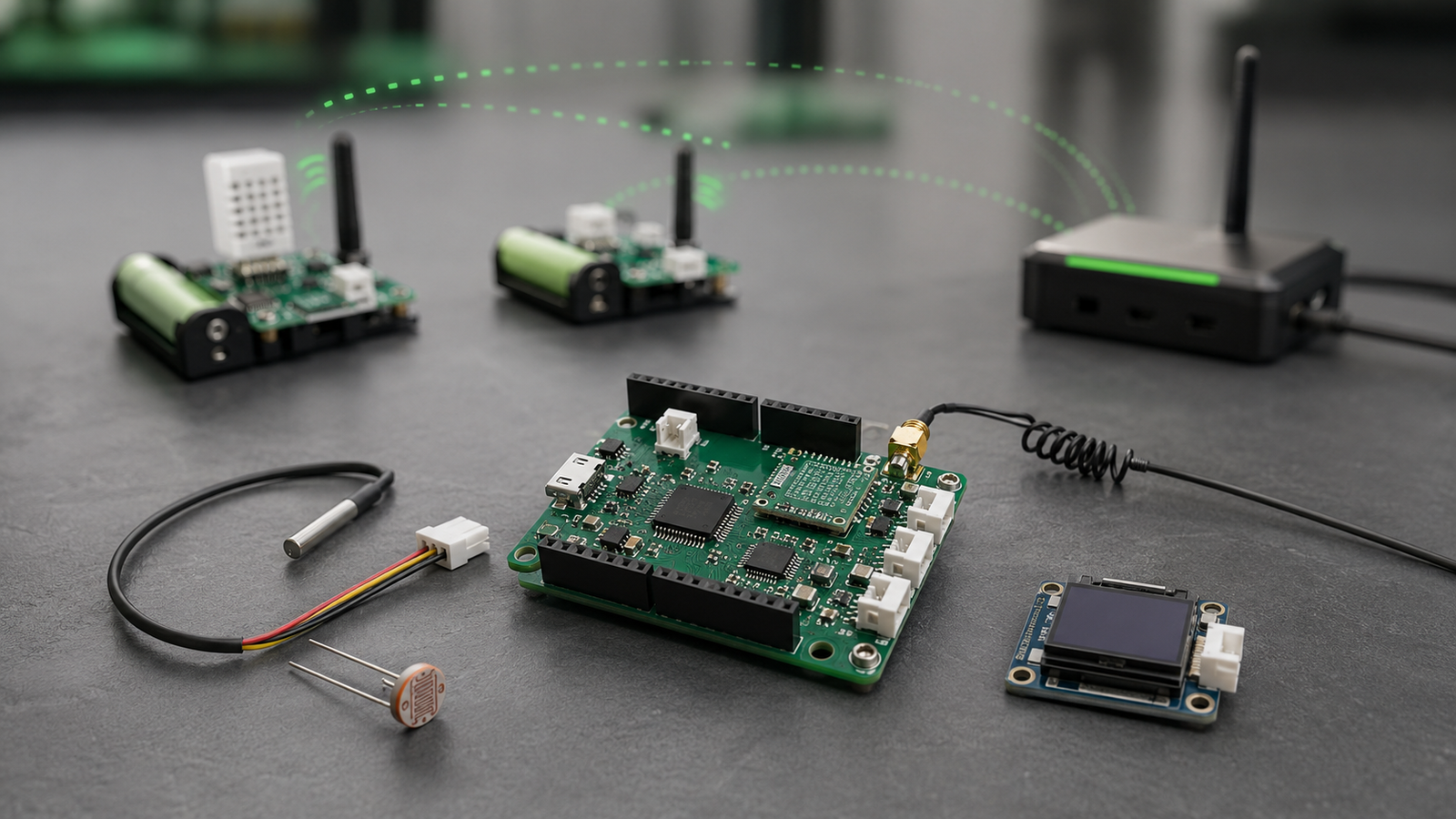
Antennino is a specific open-source, Arduino-compatible wireless board published by Open-Electronics. It combines an ATmega328P microcontroller with an RFM69 433 MHz packet-radio module for low-power sensor nodes, actuators, and gateways. It is not a generic antenna standard, and the documented board does not natively provide LoRa, Wi-Fi, or Bluetooth.
The project’s primary documentation defines its name as a portmanteau of “Antenna” and “Arduino.” This guide examines what the hardware contains, how node-to-gateway communication and over-the-air updates work, what is confirmed versus uncertain, and whether the older platform still makes sense for a new design. It also separates historical documentation from the current repository and retail status. Findings and status checks are current to July 20, 2026.
Key facts at a glance
| Item | Verified finding |
|---|---|
| Project name | Antennino |
| Entity | Open-source, Arduino-like wireless development board |
| Publisher and launch | Open-Electronics; article by Mirko Ugolini, October 2, 2018 |
| Microcontroller | Microchip/Atmel ATmega328P, 8-bit AVR |
| Radio | HopeRF RFM69 family transceiver |
| Documented frequency | 433 MHz |
| Programming ecosystem | Arduino IDE; project instructions select Arduino/Genuino Uno |
| Roles | Remote node, data gateway, and OTA gateway |
| OTA capability | Yes, using SPI flash and a wireless-capable bootloader |
| Onboard sensing | DS18B20 temperature sensor and photoresistor/light sensor |
| Expansion | Grove-style serial/RS232, I2C, digital I/O, analog, and I/O headers |
| Display | Optional small I2C OLED |
| Repository | Public; 8 commits, latest dated March 3, 2019; no published releases |
| Retail status | Availability unclear: the old direct store URL returns 404, although a related store page still surfaces a product card |
| Research date | July 20, 2026 |
Where the name came from
Open-Electronics explicitly says Antennino combines “Antenna” and “Arduino.” That primary-source explanation is more reliable for identifying the project than an unsupported claim that the term literally means “small antenna” in Italian.
Search results also contain unrelated antenna and ham radio pages. Here, the name refers only to the Open-Electronics hardware and firmware, not to generic compact antennas, LoRa boards, or a wireless protocol.
Hardware architecture, component by component
The ATmega328P is an 8-bit AVR with 32 KB flash, 2 KB SRAM, and 1 KB EEPROM. It runs the sketch, reads inputs, controls outputs, and exchanges data with peripherals. Open-Electronics documents a 16 MHz resonator and Arduino Uno-style development.
Antennino uses an SPI-controlled RFM69 radio, with an interrupt indicating packet arrival. This half-duplex sub-GHz transceiver uses modes such as FSK or OOK. Its packet engine supports CRC and AES-128, but secure keys, authentication, replay resistance, and safe updates remain system-level responsibilities.
An SPI flash chip can log readings or hold OTA firmware. Because the code references several flash-device IDs, verify the fitted part before assuming its capacity.
The DS18B20 measures temperature, while a photoresistor senses light. Four Grove-style connectors expose I2C, analog input, digital I/O, and a connection labelled RS232; verify its levels before attaching true positive-and-negative-voltage RS232 equipment. The optional I2C OLED may use an SSD1306 or SH1106 controller.
Power options are two AA cells, 3.6-12 V regulated input, or direct 3.3 V with regulators bypassed. Sleep modes and TPL5110-based power cycling support low-energy operation. The quoted 29 nA applies to the timer while the node is off, not total board consumption or promised battery life.
How the wireless link actually works
Antennino communicates locally with compatible RFM69 nodes, not directly with the internet.
- A DS18B20, photoresistor, switch, or external sensor produces a reading or event.
- The ATmega328P reads the input and prepares a data payload.
- The RFM69 transmits the packet over the configured 433 MHz network, optionally using acknowledgements and its AES engine.
- A compatible RFM69 receiver, commonly a gateway or concentrator, receives the packet.
- Gateway software may show the value on an OLED, pass it over serial to a computer, or forward it through separate network hardware.
A later Open-Electronics design uses an ESP32-plus-RFM69 gateway to bridge packets to Wi-Fi, MQTT, and ThingsBoard. Its Wi-Fi is separate from the original board.
Gateway role versus remote-node role
| Role | Main job | Practical example |
|---|---|---|
| Remote node | Read a sensor or operate an actuator | Report a door event, then sleep |
| Data gateway | Receive and expose packets from many nodes | Show readings on an OLED or pass them over serial |
| OTA gateway | Store and deliver eligible firmware | Update a matching, older node version |
A gateway is a role, not automatically a Wi-Fi router. Internet access needs a networked device, such as the ESP32 gateway.
What Does OTA Programming Mean Here
OTA, or over-the-air programming, replaces a physical serial upload with firmware transfer across the RFM69 link. This is useful when a battery sensor is mounted where connecting a cable would be inconvenient.
The documented OTA system uses a DualOptiboot-derived bootloader, external flash, a Gateway_OTA sketch, and a Windows application. A compiled HEX file goes into the gateway flash. Waking nodes send their firmware family and version, and receive an image only when the checks qualify; always-on nodes may be targeted directly.
This is not a cloud-update service. The 1 KB bootloader consumes program space, and an unsuitable sketch can prevent later OTA requests. Version checks and radio encryption do not prove signed firmware, secure boot, rollback protection, or production-grade key management.
Antennino Technical Specifications
| Specification | Verified value or qualification |
|---|---|
| CPU | ATmega328P, 8-bit AVR |
| Board clock | 16 MHz resonator, according to the project hardware article |
| MCU memories | 32 KB program flash, 2 KB SRAM, 1 KB EEPROM |
| Radio interface | SPI-controlled RFM69 with interrupt line |
| Radio band | Project firmware and documentation specify 433 MHz |
| Modulation class | Conventional RFM69 FSK/OOK packet radio; not LoRa |
| Radio primitive | CRC and AES-128; complete security is not implied |
| Additional storage | SPI flash; fitted capacity is not clearly fixed |
| Built-in sensors | DS18B20 temperature sensor and photoresistor |
| Expansion | I2C, serial/RS232 label, digital I/O, analog input; internal SPI |
| Display | Optional I2C OLED; SSD1306 or SH1106 examples |
| Antenna connection | Wire antenna pad and U.FL connector documented |
| Power | Two AA cells; 3.6-12 V input; direct 3.3 V bypass option |
| Programming | ICSP bootloader, USB-to-serial sketches, or OTA workflow |
| Native internet radio | None |
| Hardware dimensions | Not clearly documented in the reviewed primary pages |
The project describes 16 MHz operation on a 3.3 V rail, while Microchip’s guaranteed speed grade depends on voltage. Reproductions should validate this operating point against the datasheet.
Realistic projects the board can support
Open-Electronics directly proposes temperature and brightness sensing, door or window alarms, vibration sensors, and remote actuators. These match the built-in sensors, interrupt inputs, radio link, and low-power modes.
Inferred uses include water-leak contacts, mailbox switches, status beacons, or I2C environmental sensors. These are possibilities, not documented deployments. Range and battery life depend on antennas, radio settings, obstacles, interference, duty cycle, supply, and firmware.
Does Antennino support LoRa, Wi-Fi, or Bluetooth?
No such radios are built into the documented version.
| Technology | Present on the original board? | Important distinction |
|---|---|---|
| RFM69 radio | Yes | FSK/OOK-class packet radio at the configured 433 MHz |
| LoRa/LoRaWAN | No | Different modulation and hardware, such as RFM95/96/97/98 |
| Wi-Fi | No | A separate ESP32 gateway can provide Wi-Fi and MQTT |
| Bluetooth or BLE | No | No Bluetooth radio appears in the hardware or repository |
| Zigbee or cellular | No | Either requires additional hardware and software |
Operating at 433 MHz does not make a device LoRa. Frequency band and modulation are different properties.
Strengths and limitations
Strengths include Arduino-style programming, integrated sub-GHz radio and sensors, expansion, low-power options, multiple roles, OTA, and public examples. It exposes the parts of an embedded radio network clearly for learners.
Limitations include 2 KB RAM, a separate internet gateway, old repository activity, uncertain availability, and older OTA tooling. Regional 433 MHz rules vary, and AES hardware does not solve the complete security problem.
Is the project still relevant in 2026?
Antennino remains relevant for learning, restoring an existing installation, studying RFM69 networks, or reproducing an open-source design. It is harder to justify as the default platform for a new commercial product.
The repository has eight commits, last updated March 3, 2019, and no releases. Official articles remain accessible through 2021. This supports calling it a documented legacy educational project, not declaring it abandoned or maintained.
Microchip now labels the ATmega328P “Not Recommended for new designs,” although Arduino still documents the Uno R3. Existing boards remain usable, but new products should review lifecycle, supply, security, compliance, and maintenance.
Alternatives worth comparing
| Option | Processor and wireless | Internet path | Best fit | Main trade-off |
|---|---|---|---|---|
| Uno R3 plus RFM69 | 8-bit AVR plus sub-GHz module | Separate gateway | Component-level learning | More wiring, older MCU |
| Moteino RFM69 | ATmega328P/PB and RFM69 | Separate gateway | Closest integrated alternative | Verify band, stock, and MCU |
| ESP32 board | 32-bit, Wi-Fi and Bluetooth | Direct Wi-Fi | More memory and internet access | No native sub-GHz radio |
| MKR WAN 1310 | 32-bit SAMD21 and LoRa | LoRa gateway/direct | LoRa projects | Different radio and infrastructure |
Choose by requirements: RFM69, Wi-Fi, and LoRaWAN solve different problems.
Confirmed versus unclear
| Confirmed from primary sources | Unclear or revision-dependent |
|---|---|
| ATmega328P, RFM69, 433 MHz project configuration | Current retail stock and whether the product can actually be ordered |
| Uno IDE selection and serial programming | Active maintenance plans |
| DS18B20, light sensor, expansion, optional OLED | Real-world range and battery life |
| Remote node, data gateway, and OTA gateway examples | Exact external-flash part or capacity on every revision |
| Repository: 8 commits, last March 3, 2019, no releases | Deployment history and certifications |
| ATmega328P currently marked NRND | Performance and regional compliance |
Final verdict
Antennino is best understood as a thoughtfully integrated, open-source Arduino-era wireless sensor platform: an ATmega328P controls an RFM69 link, onboard sensing, expansion interfaces, low-power options, and a distinctive OTA workflow. Its educational value remains strong because the design exposes how nodes, gateways, packet radios, flash storage, bootloaders, and internet bridges fit together. Its limitations are equally clear: no native LoRa, Wi-Fi, or Bluetooth, modest 8-bit resources, separate hardware for internet access, dated repository activity, uncertain purchasing status, and engineering responsibility for security and radio compliance. For study, repair, or a compatible local experiment, the board can still be useful. For a new production device, evaluate supported modern alternatives and lifecycle risks before choosing it.
Frequently asked questions
What is Antennino?
It is an Open-Electronics Arduino-compatible board using an ATmega328P and a 433 MHz RFM69 transceiver. It supports local sensor, actuator, gateway, and OTA experiments. Its purpose is short-packet local data exchange. This is a specific hardware-and-firmware project, not a generic term for small antennas or wireless modules.
Is Antennino compatible with the Arduino IDE?
Yes. The instructions select “Arduino/Genuino Uno” and upload sketches through a 3.3 V USB-to-serial adapter after bootloader installation. The original examples also require compatible libraries. Compatibility describes the architecture and toolchain; Arduino did not manufacture the board, and modern libraries may exceed its limited AVR memory.
Does Antennino use LoRa, Wi-Fi, or Bluetooth?
The board uses an RFM69 sub-GHz packet transceiver, not LoRa, Wi-Fi, or Bluetooth. None should be inferred merely from the 433 MHz frequency. A later gateway pairs an RFM69 with an ESP32 to forward data through Wi-Fi and MQTT. That is separate hardware and does not add these radios to the original node.
What is the difference between Antennino gateway and remote-node modes?
A remote node reads a sensor or controls an actuator, often sleeping between events. A data gateway receives and displays or forwards messages from multiple nodes. The OTA gateway stores firmware and serves compatible updates when a node requests them. Each role uses a different example firmware.
Is Antennino still a good choice for a new IoT project?
It suits learning and existing RFM69 installations. Some prototypes may still favor its familiar architecture. For new commercial hardware, compare supported 32-bit controllers and radios first. Old repository activity, uncertain availability, the ATmega328P lifecycle, limited memory, external gateway, security work, and radio compliance all require review.
