


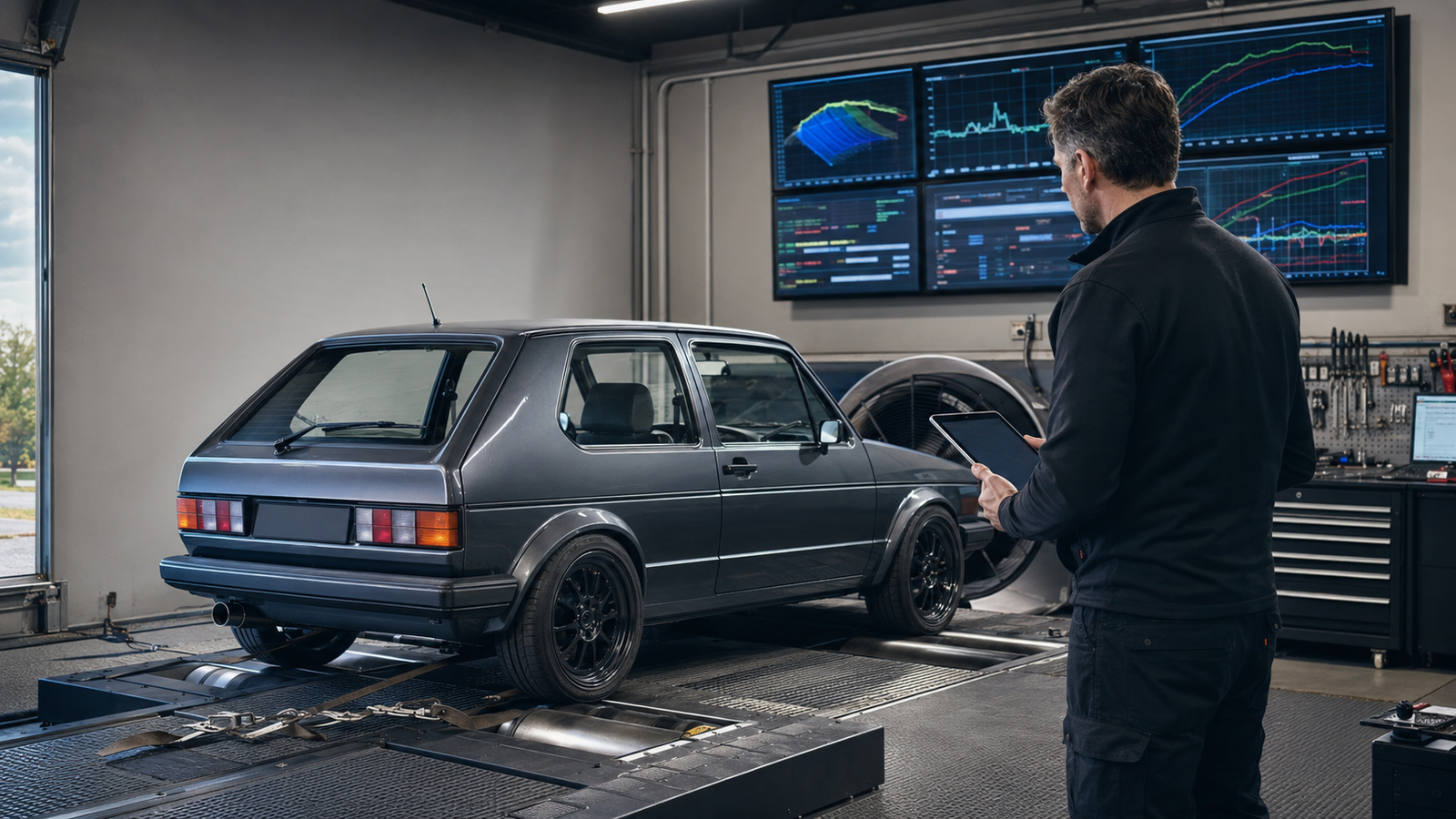
Jeroen Dik is a Dutch racing driver, automotive engineer, performance tuner, and the founder behind JD Engineering. Born in the Netherlands, he developed a reputation by combining competitive driving with detailed technical work on Volkswagen-Audi Group vehicles. His career connects early Volkswagen performance projects, the celebrated 16V G60 Mk1 Golf, advanced ECU calibration, and victory in the 2011 Toerwagen Diesel Cup.
What makes his story particularly relevant to automotive enthusiasts is the relationship between racing and workshop engineering. Track competition tested the same principles that shaped JD Engineering: controlled torque, accurate boost management, stable temperatures, smooth drivability, and dependable performance. Instead of treating maximum horsepower as the only objective, Dik built his name around cars that delivered power consistently. That philosophy helped establish him as a recognised figure among Volkswagen, Audi, Seat, and Skoda performance enthusiasts.
Career Profile at a Glance
| Profile detail | Information |
|---|---|
| Full name | Jeroen Dik |
| Nationality | Dutch |
| Professional roles | Racing driver, automotive engineer, tuner, and company founder |
| Company | JD Engineering |
| Meaning of JD | Jeroen Dik |
| Main specialisation | Volkswagen-Audi Group performance tuning |
| Associated brands | Volkswagen, Audi, Seat, and Skoda |
| Notable racing series | Toerwagen Diesel Cup |
| Championship year | 2011 |
| Associated race car | Volkswagen Golf VI TDI |
| Engineering focus | ECU calibration, usable torque, thermal control, reliability, and drivability |
| Company location | Lochem, the Netherlands |
From Mechanical Curiosity to Performance Engineering
The early part of Dik’s technical career developed during a period when European Volkswagen tuning was becoming increasingly sophisticated. Enthusiasts were discovering the performance possibilities of electronic engine management, forced induction, and improved fuel and ignition control.
His interests extended beyond fitting performance components. The greater challenge was understanding how mechanical hardware and electronic calibration behaved as a complete system. An engine could receive more air through a turbocharger or supercharger, but that additional airflow had to be supported by suitable fuelling, ignition behaviour, temperature control, and ECU management.
This systems-based outlook became central to Jeroen Dik’s work. A powerful engine that responded unpredictably, lost performance when hot, or placed excessive strain on its transmission was not a complete result. Balanced delivery mattered as much as peak output.
Understanding Power Beyond the Dyno Number
Horsepower describes how quickly an engine can perform work, while torque represents rotational force. Both are important, but they affect the driving experience differently.
A large horsepower figure may attract attention, yet a road car spends much of its time below maximum engine speed. Well-managed torque across a broad operating range can therefore make the vehicle feel stronger and more responsive during ordinary acceleration.
However, a sudden torque spike can overpower the tyres, disturb the chassis, and increase stress on the clutch or transmission. Dik’s developing philosophy placed greater importance on controlled delivery. The objective was not simply to produce additional power, but to make it accessible and predictable.
How JD Engineering Developed
JD Engineering takes its initials directly from the name of its founder. JD stands for Jeroen Dik, connecting the company’s identity with his personal engineering standards.
Established in the Netherlands, the business developed around performance calibration for Volkswagen-Audi Group vehicles. Its work became associated with Volkswagen, Audi, Seat, and Skoda models, including engines using turbochargers and superchargers.
The workshop approach extended beyond applying a generic software file. Effective calibration requires an understanding of the individual engine, its supporting hardware, the transmission, and the conditions under which the car will be used.
The company’s work has included areas such as:
- Custom ECU calibration
- Transmission control unit tuning
- Turbocharger and supercharger optimisation
- Dyno testing
- Data logging and diagnostic analysis
- Integration of intake, exhaust, and turbo upgrades
- Track and endurance support
- Reliability-focused performance development
A dynamometer allows engineers to measure how a vehicle performs under controlled load. Data logging then records parameters such as requested torque, boost behaviour, fuel delivery, ignition activity, intake temperature, and protection-system intervention. Together, these tools help replace assumptions with measurable evidence.
Why VAG Performance Became His Specialisation
Volkswagen-Audi Group platforms share many engines, electronic systems, transmissions, and underlying engineering principles across multiple brands. That creates a large but technically demanding field for specialist tuning.
Volkswagen models may use systems related to those found in an Audi, Seat, or Skoda, but vehicle weight, transmission configuration, cooling capacity, and factory calibration can vary. A successful tuner must understand both the shared architecture and the differences between individual applications.
Dik’s association with VAG tuning developed around this deeper platform knowledge. ECU remapping was treated as the coordination of interconnected systems, not merely an increase in fuel or boost.
A modern engine-management system may supervise:
- Driver torque requests
- Throttle behaviour
- Airflow and boost pressure
- Fuel quantity and air-fuel calibration
- Ignition or injection timing
- Exhaust gas temperature protection
- Transmission torque limits
- Traction-related intervention
- Engine and coolant temperatures
- Diagnostic and safety functions
Changes in one area can influence several others. Additional boost may increase cylinder pressure and heat, while a sudden torque request can affect tyre grip and transmission durability. Successful calibration must keep these relationships in balance.
The 16V G60 Mk1 Golf and a Growing Reputation
One of the vehicles most closely connected with Jeroen Dik’s early reputation is the 16V G60 Mk1 Golf. The build combined the lightweight character of the first-generation Golf with a 16-valve engine and G60 supercharging.
Forced induction uses a compressor to push additional air into the engine. A turbocharger is driven by exhaust gases, while a supercharger is mechanically driven by the engine. The G60 system required careful management because greater airflow alone could not guarantee a refined or durable result.
Fuelling, charge temperature, ignition behaviour, intercooling, and throttle response all needed to work together. The project demonstrated a complete-vehicle approach in which performance was developed without discarding normal road manners.
Its significance was not limited to speed. The car represented a version of performance that could remain usable outside a controlled workshop or racing environment. A strong modified vehicle should start properly, idle consistently, respond progressively, and behave predictably in traffic as well as under full acceleration.
That combination of pace and civility helped shape the identity later associated with JD Engineering. The Mk1 Golf showed that an extensively developed car did not need to feel unfinished or unnecessarily aggressive.
From Tuning Workshop to the Toerwagen Diesel Cup
Motorsport created an opportunity to test the same engineering principles under sustained pressure. The 2011 Toerwagen Diesel Cup placed production-based diesel touring cars in an environment where performance depended on much more than a brief burst of power.
Diesel engines can produce substantial low-speed and mid-range torque. That characteristic is useful for acceleration, but it can also create traction, heat, and drivetrain-management challenges. On a racing circuit, the car must repeatedly accelerate, brake, and operate under load while maintaining predictable behaviour.
Jeroen Dik entered the championship in a Volkswagen Golf VI TDI. His involvement combined the responsibilities of a driver with those of an engineer, allowing feedback from behind the wheel to influence technical development.
Developing the Volkswagen Golf VI TDI
The race car reflected several important areas of his engineering approach.
Engine calibration: The ECU mapping had to provide strong acceleration without delivering torque so abruptly that the front tyres lost traction.
Boost management: Turbocharger response needed to remain consistent across different gears and operating conditions. Excessively aggressive boost could create heat or make the car difficult to control.
Thermal stability: Racing places an engine under sustained load. Intake temperatures, coolant behaviour, and exhaust gas temperatures therefore required close attention.
Drivetrain behaviour: Engine output had to remain compatible with the clutch, gearbox, and other transmission components. Power that repeatedly triggered protection strategies would not provide dependable racing performance.
Chassis balance: A front-engined diesel hatchback carries considerable weight toward the front. Smooth torque delivery helps the driver manage corner exits without unnecessarily destabilising the car.
Championship Success in 2011
Dik won the 2011 Toerwagen Diesel Cup championship in the Golf VI TDI. The result connected his workshop reputation with success in a competitive motorsport environment.
A championship is not normally secured through one impressive dyno run or one quick lap. It requires the vehicle to perform repeatedly across an entire campaign. Reliability, consistency, temperature control, vehicle development, and disciplined driving all contribute to the final result.
For JD Engineering, the championship also provided meaningful technical validation. The principles applied to tuned road cars had survived the greater demands of racing. Controlled power delivery and mechanical dependability were not conservative alternatives to performance. They were part of what made sustained performance possible.
The Engineering Principles Behind the Cars
Usable Torque Before Dramatic Peaks
A large torque spike can make a car feel powerful for a moment, but it may also overwhelm available grip and place a sudden load on drivetrain components. A broader, more progressive torque curve usually gives the driver greater control.
Dik’s approach is associated with power that builds predictably. This can improve acceleration because the tyres are more capable of transferring the engine’s output to the road.
Good calibration also considers how torque is delivered in different gears. Lower gears may require careful management to preserve traction, while higher gears place the engine under load for longer periods.
ECU Calibration as System Management
ECU remapping involves changing the software parameters used by the engine-management system. On a modern vehicle, this process is considerably more complex than requesting extra fuel and boost.
Many ECUs use torque-based logic. The driver presses the accelerator, the control system interprets the request, and several modules coordinate the response. Engine output, transmission limits, traction systems, throttle position, airflow, and protection functions can all participate.
A properly developed map works with that logic. It adjusts the relevant models and limits coherently so that the ECU can continue managing the engine predictably.
Air-fuel calibration is one part of the process. The engine needs a suitable relationship between the air entering the cylinders and the fuel being delivered. Inaccurate calibration can harm performance, create excessive temperatures, or cause unreliable behaviour.
Boost Control, Traction, and Drivability
Boost control determines how the turbocharger or supercharger contributes to engine airflow. High pressure is not automatically better. The correct target depends on engine speed, load, gear, thermal conditions, and the capabilities of the supporting hardware.
Progressive control can reduce wheelspin and make the accelerator easier to modulate. It can also protect the transmission from unnecessarily abrupt torque.
Drivability covers the qualities a driver notices in ordinary use: smooth starting, stable idling, predictable throttle response, clean part-load operation, and controlled transitions into boost. These details distinguish a complete calibration from one designed only to produce an impressive maximum figure.
Heat Management Is Part of Performance
Forced-induction engines generate heat, particularly during repeated acceleration or sustained high load. As intake temperature rises, the engine may become more vulnerable to abnormal combustion or begin reducing output for protection.
Exhaust gas temperature, commonly shortened to EGT, is another important measurement. Excessive EGT can place the turbocharger, exhaust valves, and related components under severe thermal stress.
Effective thermal management may involve:
- Suitable engine cooling
- Efficient charge-air cooling
- Controlled boost targets
- Accurate fuelling
- Appropriate ignition or injection strategies
- Monitoring intake and exhaust temperatures
- Matching hardware capacity to the requested output
A car that produces strong power when cold but quickly loses it as temperatures rise is not delivering repeatable performance. Cooling supports consistency, and consistency determines how useful the output really is.
Reliability and Transmission Protection
Mechanical reliability is affected by both the amount of power produced and the way that power arrives. Gradual, controlled torque can be easier on components than a sharp mid-range surge, even when peak output is similar.
Transmission protection is therefore part of engine calibration. The ECU and transmission controller must share compatible torque information. If one system requests more than the other can safely manage, the result may include harsh shifting, clutch slip, intervention, or accelerated wear.
This relationship is especially important in tuned vehicles where factory torque levels are being exceeded. Engine and transmission behaviour must be developed as a coordinated package.
OEM-Plus Performance Without Losing Factory Manners
OEM-plus tuning aims to improve a factory vehicle while preserving the qualities that make it practical. In this context, the term is not limited to subtle visual modifications. It describes an engineering approach.
A successful OEM-plus car should feel stronger without feeling crude. Cold starts, idle quality, low-speed control, throttle progression, and transmission response remain important even when additional performance is available.
Jeroen Dik became associated with this balance. The objective was to work with the original vehicle’s systems and character rather than making every modification obvious to the driver.
The result is a car that can behave calmly during normal use and deliver stronger acceleration when requested. That dual character is particularly valuable to VAG owners who want everyday practicality alongside improved performance.
How Racing and Workshop Development Support Each Other
Racing exposes weaknesses quickly. A cooling system that seems adequate during a short road test may struggle after repeated high-load laps. A torque curve that feels exciting on the street may make corner exits difficult on a circuit. A calibration that produces a strong initial run may become inconsistent as temperatures rise.
Workshop testing supplies a controlled environment for investigating those problems. Dyno measurements can reveal whether torque delivery is stable, while data logs help engineers examine what the ECU is requesting and how the vehicle is responding.
The development cycle works in both directions:
- Workshop testing creates a measurable baseline.
- Track use places the vehicle under sustained real-world stress.
- Driver feedback identifies behaviour that data alone may not fully describe.
- Logged information reveals thermal, boost, fuelling, or torque-control issues.
- Revised calibration can be tested again under controlled conditions.
- Further circuit use confirms whether the change remains effective under pressure.
Dik’s driver-engineer role shortened the distance between observation and technical response. He could experience the car’s behaviour directly and connect that feeling with recorded data.
Practical Lessons from Jeroen Dik’s Approach
The value of his career is not limited to one race car or one workshop. Several principles apply broadly to responsible performance development.
Begin With Mechanical Health
Modification should start with a healthy vehicle. Existing faults, worn components, cooling problems, or unreliable sensors can become more serious when the engine is asked to produce additional output.
Measure Before Making Claims
Dyno testing and data logging provide evidence. A single peak number does not explain temperature stability, torque delivery, correction activity, or performance across the operating range.
Keep Torque Controllable
The strongest possible mid-range surge is not always the quickest or most enjoyable solution. Power should match the grip, transmission, chassis, and intended use of the vehicle.
Respect Factory Control Logic
Modern ECUs contain interconnected models, limits, and protection strategies. Good calibration understands their purpose and modifies the system coherently.
Treat Cooling as Supporting Hardware
An upgraded engine cannot perform consistently if charge-air, coolant, or exhaust temperatures exceed sensible operating limits. Thermal capacity should match the expected workload.
Preserve Everyday Behaviour
Throttle response, idle stability, cold starting, part-load driving, and smooth shifting are performance qualities too. A fast vehicle should not become unnecessarily difficult to use.
Prefer Repeatable Results
Measured, repeatable acceleration is more valuable than a one-time figure achieved under ideal conditions. The best setup is one that continues performing predictably on the road or circuit.
Influence Across the European VAG Community
VAG enthusiasts recognise Jeroen Dik because his work connects several areas of automotive culture. The 16V G60 Mk1 Golf appealed to Volkswagen performance fans, JD Engineering became associated with specialised calibration, and the Toerwagen Diesel Cup demonstrated that his principles could succeed in motorsport.
Consistency played an important role in that reputation. Workshop cars and racing vehicles were linked by the same focus on balanced output, thermal control, and usable drivability.
His approach also offers an alternative to performance culture built around maximum figures. A well-developed car must transfer its power to the road, manage heat, communicate correctly with its transmission, and remain dependable.
This thinking continues to influence how serious enthusiasts evaluate modifications. The question is no longer only how much power a car produces. It is also how smoothly, safely, and consistently that performance can be used.
A Career Built Between the Driver’s Seat and the Dyno
The career of Jeroen Dik is defined by the interaction between practical driving and engineering analysis. JD Engineering gave that approach a permanent workshop identity, while the G60 project demonstrated its potential in an enthusiast vehicle.
The 2011 championship added competitive proof. The Volkswagen Golf VI TDI had to combine diesel torque with traction, cooling, consistency, and reliability across a demanding racing season.
Together, these achievements explain why Dik is remembered as both a driver and an engineer. His contribution to VAG tuning was not simply the pursuit of faster cars. It was the development of performance that remained controlled, measurable, and suitable for its intended use.
Why His Engineering Legacy Still Matters
From early forced-induction Volkswagen projects to the creation of JD Engineering, Jeroen Dik built a career around the idea that extra output must remain usable. The 16V G60 Mk1 Golf strengthened his standing among enthusiasts, while the 2011 Toerwagen Diesel Cup demonstrated how calibration, cooling, traction, and reliability operate together under racing pressure.
His engineering philosophy remains relevant because modern performance cars are integrated electronic and mechanical systems. More boost or fuel cannot replace careful testing, accurate data, and respect for drivetrain limitations. Strong results depend on how well every component works together.
That is the lasting value of his driver-engineer identity. Jeroen Dik showed that reliable VAG performance is not defined by one headline number. It is built through disciplined calibration, measured development, smooth delivery, and the ability to perform consistently when conditions become demanding.
The Lasting Impact of a Driver-Engineer
Jeroen Dik’s career shows how disciplined engineering can turn performance into something both exciting and dependable. His early work with forced-induction Volkswagen engines, the development of the 16V G60 Mk1 Golf, and the creation of JD Engineering established a clear philosophy: additional power should never come at the expense of control, drivability, or reliability. His 2011 Toerwagen Diesel Cup victory strengthened that reputation by proving the same principles under demanding racing conditions. Careful ECU calibration, progressive torque delivery, effective cooling, and data-led testing remained central to his approach. Through JD Engineering, those lessons have influenced how European VAG enthusiasts think about modified cars. His legacy is therefore not based on one championship or a single famous build. It rests on a consistent belief that the best performance car is not simply powerful, but balanced, measurable, mechanically sound, and enjoyable every time it is driven.
Frequently Asked Questions
Who is the Dutch racer and engineer behind JD Engineering?
Jeroen Dik is a Dutch racing driver, automotive engineer, tuner, and company founder. He is known for establishing JD Engineering, developing performance Volkswagen vehicles, and winning the 2011 Toerwagen Diesel Cup in a Volkswagen Golf VI TDI. His work connects motorsport experience with data-led VAG performance calibration.
How did JD Engineering receive its name?
The initials JD stand for Jeroen Dik, directly linking the business to its founder. The company developed around his technical approach to Volkswagen-Audi Group performance, with attention given to ECU calibration, forced-induction systems, dyno testing, drivability, thermal stability, and dependable power delivery.
Which motorsport title did Dik secure?
He won the 2011 Toerwagen Diesel Cup, a Dutch touring-car championship for diesel-powered vehicles. Dik competed in a Volkswagen Golf VI TDI that reflected his engineering priorities, including manageable torque, reliable boost delivery, effective cooling, and consistent performance throughout the racing campaign.
Which types of vehicles are associated with JD Engineering?
JD Engineering specialises primarily in vehicles from the Volkswagen-Audi Group. These include Volkswagen, Audi, Seat, and Skoda models, particularly cars using turbocharged or supercharged engines. Its work includes engine and transmission calibration, dyno development, diagnostic analysis, hardware integration, and performance tuning focused on factory-style drivability.
Where can JD Engineering be found?
JD Engineering is based in Lochem in the Netherlands. From this location, the company has developed its reputation within the European VAG community through calibration work, dyno testing, performance development, and experience connecting tuned customer vehicles with lessons learned through motorsport.
