


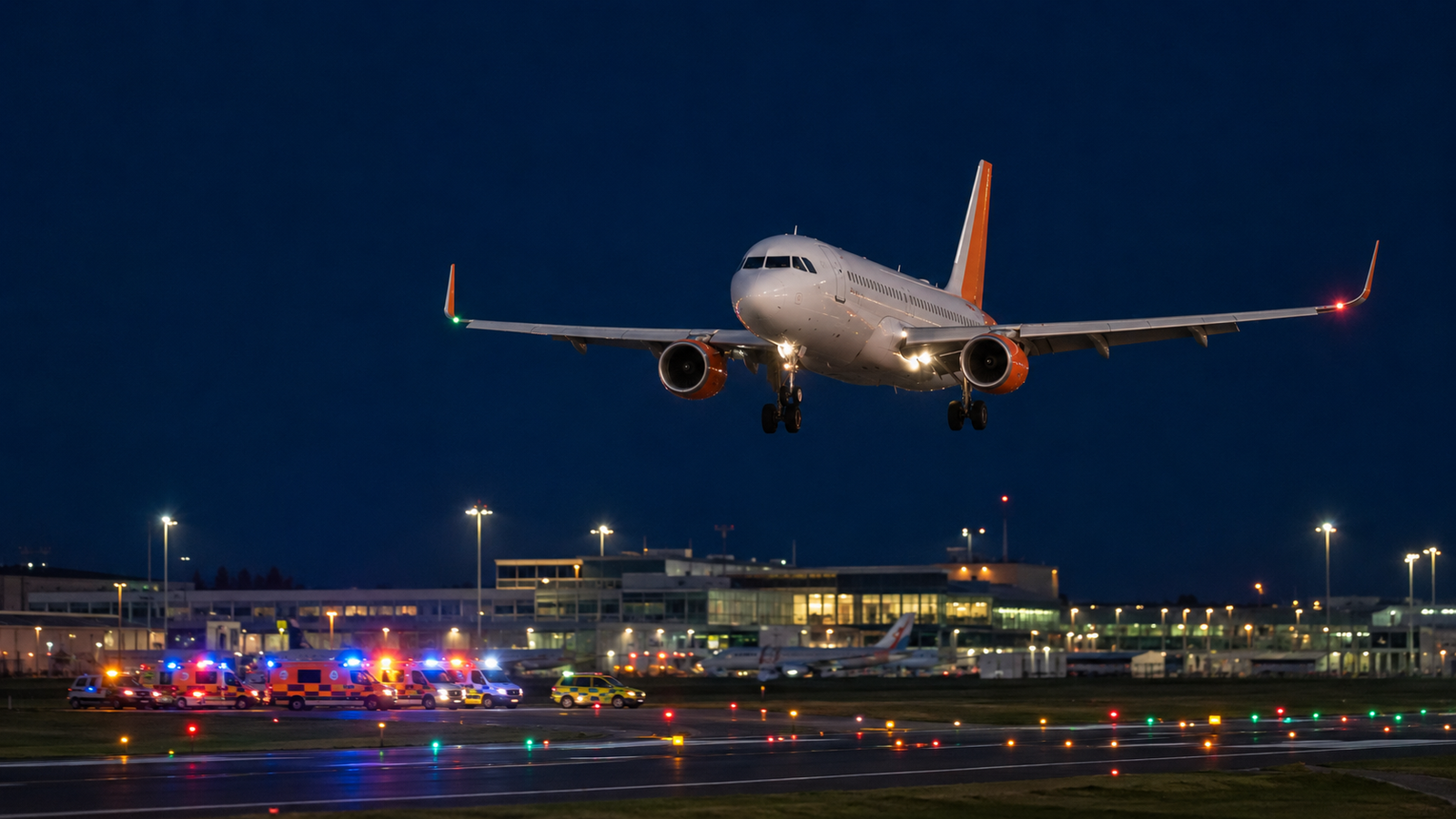
easyJet Flight U2238, travelling from Copenhagen to Manchester on 27 October 2025, diverted after a passenger required urgent medical attention. The easyJet flight U2238 emergency landing in Newcastle was therefore a medical diversion, not a reported aircraft malfunction. The Airbus A320 landed safely at Newcastle Airport at approximately 22:52 GMT, where emergency services were ready to respond. After the medical situation had been handled, the aircraft resumed its journey to Manchester. This calm, fact-based account clearly explains why the crew changed course, what the emergency code meant, how Newcastle supported the response, and what happened after the safe landing. Incident details
In short, Flight U2238 left Copenhagen for Manchester but diverted while approaching England’s east coast because a passenger needed urgent care. The crew declared a general emergency, Newcastle gave the aircraft priority handling, and medical personnel met it after a safe landing. The remaining journey later continued to Manchester.
Essential Details at a Glance
| Detail | Confirmed information |
|---|---|
| Airline | easyJet |
| Flight | U2238 |
| Date | 27 October 2025 |
| Planned route | Copenhagen to Manchester |
| Aircraft | Airbus A320 |
| Reported reason | A passenger required urgent medical attention |
| Emergency code | Squawk 7700 |
| Diversion airport | Newcastle Airport |
| Landing | Safe, at approximately 22:52 GMT |
| Ground response | Emergency services and medical personnel were waiting |
| Onward journey | The flight continued to Manchester after a short stop |
How a Routine Flight Became a Medical Diversion
The evening service left Copenhagen and followed its normal route across the North Sea. The situation changed as the aircraft approached England’s east coast and someone on board required urgent medical attention.
The crew declared a general emergency and changed the destination from Manchester to Newcastle. That placed the passenger’s needs ahead of completing the scheduled route. Although a diversion causes delay, it can provide faster access to professional assistance.
Nothing in the account indicates a mechanical or structural problem. The emergency concerned a customer needing medical care. That distinction matters because “emergency landing” can suggest aircraft failure even when the priority is a person’s health.
Why Newcastle Was the Practical Choice
Newcastle was described as the closest suitable airport. The aircraft was approaching Britain from the northeast, making it a practical place to obtain help without continuing to Manchester.
Suitability involves more than finding the nearest airfield. Newcastle could accept the Airbus A320 and support an urgent arrival with an appropriate runway, air traffic control, emergency services, and medical assistance.
Landing at Newcastle allowed medical professionals to reach the passenger sooner. The diversion was a controlled safety decision based on the aircraft’s position and the need for urgent ground assistance.
How the Crew and Controllers Managed the Emergency
The passenger needed attention in the cabin, while the pilots had to communicate with air traffic control and arrange a prompt, safe landing.
The emergency declaration enabled controllers to prioritise the aircraft, clear its route towards Newcastle, manage surrounding traffic, and warn the airport. This gave emergency and medical teams time to prepare.
This coordination reduced delay. The pilots could divert, controllers provided priority handling, and responders were ready when the aircraft landed. Separate teams worked as one connected response.
What Squawk 7700 Communicated
The aircraft reportedly transmitted Squawk 7700, a general emergency transponder code that makes its priority status clear to air traffic control.
The code does not reveal the cause. It cannot tell observers whether the situation involves a passenger, an aircraft system, or another urgent problem. It alerts controllers that priority handling is required.
Here, the surrounding information supplied the context: a passenger medical emergency. Squawk 7700 supported the urgent response but was not evidence of a technical fault.
EasyJet flight U2238 Emergency Landing Newcastle: What Happened on Arrival
Flight U2238 landed safely at Newcastle at approximately 22:52 GMT. Emergency services were waiting, allowing the affected passenger to receive professional assistance sooner.
Response vehicles may have underlined the diversion’s seriousness for other passengers. However, positioning emergency personnel before an urgent arrival is preparation, not evidence of an unstable landing. The aircraft arrived safely, and medical staff took responsibility on the ground.
No further medical details were provided. A diagnosis, treatment, or later outcome should not be assumed. The confirmed point is that urgent care was required and the diversion made it available sooner.
What Followed the Stop at Newcastle
After the medical emergency had been addressed, the aircraft continued to Manchester. The remaining passengers completed the planned journey after a delay.
There was no confirmed evidence of a technical problem, and the Airbus resumed its journey after the short stop. That sequence does not indicate an unresolved serious aircraft fault.
The original emergency remained serious enough to change the flight plan. It concerned a person on board rather than a reported aircraft failure.
Why an Emergency Landing Is Not the Same as an Accident
An emergency landing is a priority procedure. It means the crew has identified an urgent situation and wants to land promptly. It does not automatically indicate a crash, dangerous approach, or mechanical breakdown.
Here, controllers gave the aircraft priority, responders prepared, and the Airbus landed without a reported accident. The passenger’s medical need was serious, while the flight remained capable of continuing afterwards.
Precise language avoids both minimisation and unnecessary alarm. This emergency required quick action, but the response was controlled, and the landing was safe.
What the Response Reveals About Aviation Safety
The incident shows several layers of aviation preparation. The crew decided not to wait until Manchester, air traffic control supported a prioritised diversion, and Newcastle prepared emergency and medical personnel.
The diversion was itself the safety measure. It shortened the wait for medical assistance while keeping the arrival organised.
The most important lessons are straightforward:
- Passenger health can justify an immediate change of destination.
- The closest suitable airport may be chosen instead of the scheduled one.
- Squawk 7700 communicates a general emergency, not its specific cause.
- Ground responders can prepare while controllers guide the aircraft in.
- A safe onward flight can follow once the cause of a medical diversion has been addressed.
Conclusion
Flight U2238 changed course during its Copenhagen-to-Manchester journey because a passenger needed urgent medical attention. The crew declared a general emergency, air traffic control prioritised the Airbus A320, and Newcastle Airport prepared responders for its arrival. The aircraft landed safely at approximately 22:52 GMT, allowing medical personnel to assist the passenger. After a short stop, it continued to Manchester with the remaining travellers.
The easyjet flight u2238 emergency landing newcastle shows why calm coordination matters during an unexpected event. The diversion was not a reported crash or aircraft failure. It was a safety-first response that connected the crew, controllers, airport services, and medical personnel so urgent help could be provided as quickly as possible.
Frequently Asked Questions
Why did the easyJet service divert to Newcastle?
A passenger required urgent medical attention as the aircraft approached England’s east coast. Newcastle was the closest suitable airport, giving the crew a faster way to place the passenger in professional care than continuing to Manchester.
Was the Airbus A320 experiencing a technical fault?
There was no confirmed evidence of a mechanical or structural fault. A customer required urgent medical attention, and the aircraft’s later continuation to Manchester is consistent with a medical diversion rather than an unresolved technical problem.
What did Squawk 7700 mean during the flight?
Squawk 7700 is a general emergency transponder code. It alerts air traffic control that the flight requires priority attention but does not specify the problem. It should not be treated as proof of a technical malfunction.
Did Flight U2238 eventually reach Manchester?
Yes. After landing safely at Newcastle and making a short stop, the flight continued to its original destination. The remaining passengers reached Manchester after the medical situation had been handled on the ground.
Was anyone reported to have died in the incident?
No reliable fatality was reported. Medical personnel met the affected passenger after landing, but no further details about the person’s condition or outcome were disclosed. Any more specific claim would be speculation.
