


Modern businesses generate massive amounts of data every single day. From customer behavior and sales performance to inventory tracking and employee productivity, companies now rely heavily on information to make decisions. The problem is that traditional systems often fail to process this data quickly and efficiently.
This is where Cñims enters the conversation.
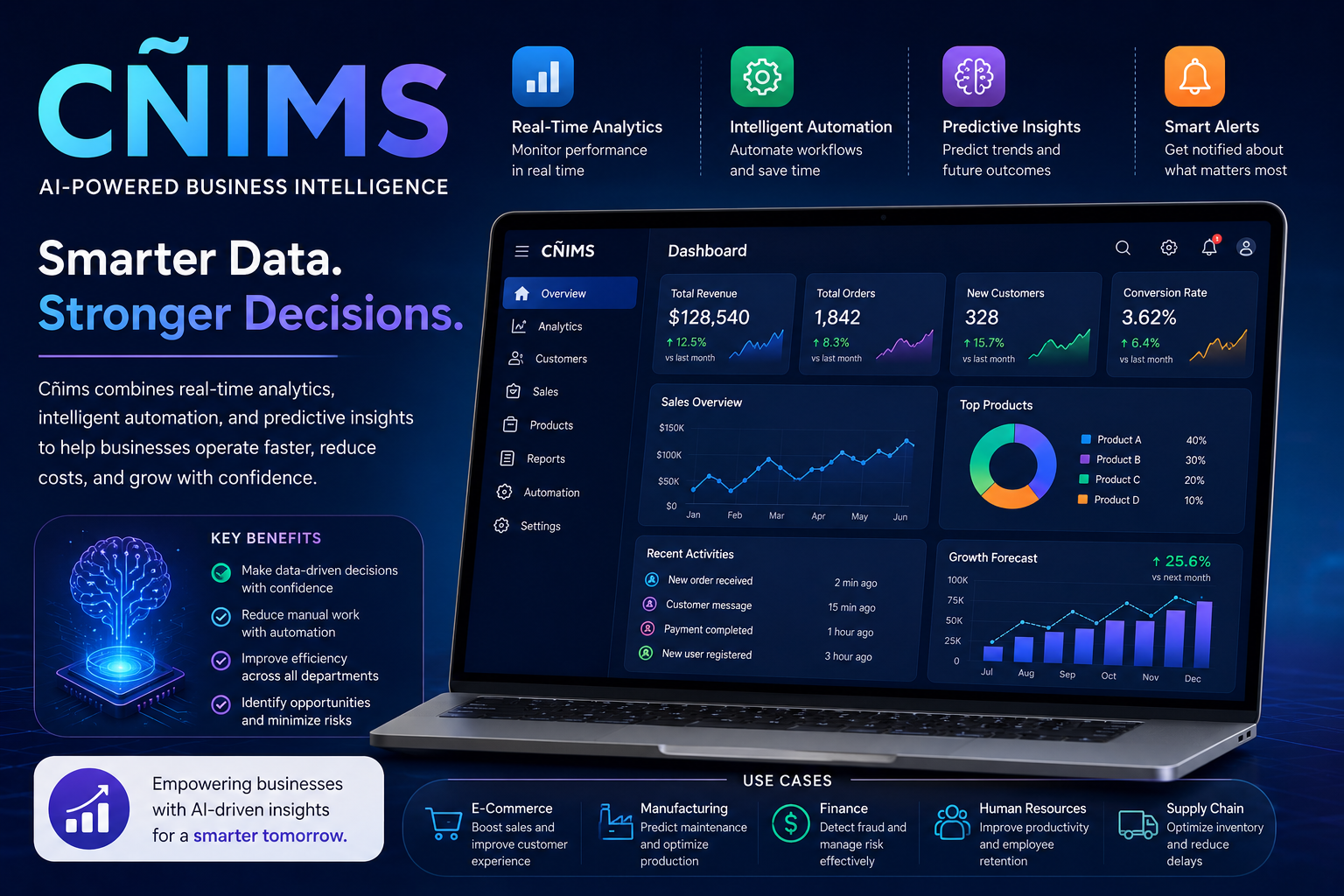
Cñims is being discussed as a modern approach to AI-driven business intelligence that combines automation, real-time analytics, and intelligent monitoring into one connected system. Instead of relying on manual reports or outdated spreadsheets, businesses can use intelligent systems to analyze data instantly and make faster decisions.
For startups, business owners, and technology professionals, this shift is becoming increasingly important. Companies want tools that not only collect information but also explain what the data actually means.
In this guide, we will explore how Cñims works, why businesses are interested in AI business analytics, and how intelligent management systems are changing the future of operations.
What Is Cñims and How Does It Work?
Cñims can be described as an intelligent business management concept that combines:
- AI business analytics
- Real-time data monitoring
- Automation tools
- Predictive insights
- Operational tracking
The purpose of Cñims is simple: help organizations make smarter and faster decisions using live business data.
Traditional business systems usually require managers to manually review reports, compare spreadsheets, or wait for weekly updates before taking action. Cñims changes this process by continuously analyzing data in real time.
For example, imagine an online store experiencing a sudden drop in sales. A traditional system might only reveal the issue after several days. A real-time analytics platform powered by intelligent automation could detect the problem instantly and notify managers before major losses occur.
This proactive approach is one reason why businesses are moving toward intelligent management systems.
Core Functions of Cñims
A Cñims-style platform may include features such as:
- Live dashboard reporting
- Automated alerts
- Customer behavior tracking
- Sales trend analysis
- Workflow automation
- Predictive forecasting
- Team performance monitoring
These tools work together to simplify business operations and reduce manual effort.
How Cñims Uses Real-Time Analytics for Smarter Decisions
Real-time data monitoring is one of the biggest advantages of AI-powered business intelligence.
In older systems, businesses often worked with delayed information. By the time managers reviewed reports, the situation may already have changed. Cñims focuses on live analytics so businesses can respond immediately.
Example: Retail Store Monitoring
Suppose a retail company notices that one product suddenly starts selling faster than expected.
A traditional system might update inventory reports at the end of the day. Meanwhile, stock shortages could already be happening.
With intelligent analytics:
- Inventory updates instantly
- AI predicts future demand
- Automated purchase orders may be triggered
- Managers receive alerts before shortages occur
This helps companies avoid lost sales opportunities.
Example: Customer Support Performance
A customer support department can also benefit from AI business analytics.
If customer complaints increase suddenly, the system may detect:
- Longer response times
- Repeated complaint topics
- Negative customer sentiment
Managers can then assign more support staff or improve processes before customer satisfaction declines further.
This ability to react quickly gives businesses a competitive advantage.
Business Operations That Can Improve with Cñims
One reason Cñims is gaining attention is its flexibility across industries. Different departments can use intelligent automation in different ways.
Sales and Marketing
Marketing teams can analyze customer behavior patterns and improve campaigns using predictive business insights.
For example:
- Identifying which advertisements generate the highest conversions
- Predicting which products customers may purchase next
- Tracking audience engagement in real time
This allows businesses to spend marketing budgets more effectively.
Finance and Accounting
Financial departments can automate repetitive tasks such as:
- Invoice tracking
- Expense monitoring
- Cash flow forecasting
- Fraud detection
AI systems can also identify unusual financial activity faster than manual reviews.
Human Resources
HR departments can use intelligent management systems to monitor:
- Employee productivity
- Recruitment trends
- Staff attendance patterns
- Training performance
Predictive analytics may even help companies identify employee retention risks before turnover increases.
Supply Chain and Inventory
Businesses dealing with logistics and inventory often face delays, shortages, and operational inefficiencies.
Cñims-style systems can help by:
- Monitoring stock levels live
- Predicting demand spikes
- Improving warehouse organization
- Reducing unnecessary inventory costs
These improvements save both time and money.
Why Companies Are Moving Toward Intelligent Automation
Business environments are becoming more competitive every year. Companies no longer want systems that simply store information. They want systems that actively assist with decision-making.
This is why business automation is expanding rapidly.
Reduced Manual Work
Many organizations still spend hours creating reports manually. Intelligent automation reduces repetitive tasks and allows teams to focus on higher-value work.
For example:
- Automated reporting
- Smart scheduling
- AI-generated insights
- Workflow optimization
This increases efficiency across departments.
Faster Decision-Making
In fast-moving industries, delayed decisions can lead to lost revenue.
AI-powered analytics allow companies to:
- Detect issues immediately
- Respond faster to market changes
- Improve operational speed
- Track performance continuously
The faster a company reacts, the better its chances of staying competitive.
Better Accuracy
Humans can miss patterns in large datasets. AI systems are designed to process huge amounts of information more accurately and consistently.
This improves forecasting, risk analysis, and operational planning.
Cñims vs Traditional Business Management Methods
Businesses often compare intelligent systems with older management approaches to understand the real benefits.
| Feature | Traditional Systems | Cñims-Style Intelligent Systems |
|---|---|---|
| Reporting Speed | Delayed reports | Real-time monitoring |
| Decision Support | Manual analysis | AI-driven insights |
| Automation | Limited | Advanced workflow automation |
| Data Processing | Slower | Continuous live analysis |
| Predictive Capabilities | Minimal | Predictive business insights |
| Efficiency | Labor-intensive | Streamlined operations |
Traditional systems are still useful for basic operations, but they often struggle with large-scale data analysis and rapid business changes.
Cñims represents a more adaptive and proactive approach.
Real-World Business Benefits of AI-Driven Analytics
Many companies are already using AI business analytics to improve operations.
Example 1: E-Commerce Optimization
An online store may use predictive analytics to recommend products based on customer browsing behavior.
Benefits include:
- Higher sales conversions
- Better customer experience
- Increased average order value
Example 2: Manufacturing Efficiency
Manufacturing companies can monitor equipment performance in real time.
AI systems may detect:
- Machine overheating
- Maintenance needs
- Production delays
This helps prevent downtime and improves productivity.
Example 3: Banking and Fraud Detection
Financial institutions use intelligent monitoring systems to identify suspicious activity.
AI can detect unusual transactions faster than manual systems, helping reduce fraud risks.
Example 4: Healthcare Analytics
Healthcare organizations use predictive systems to analyze patient data, improve scheduling, and manage resources more efficiently.
These practical examples show why intelligent management systems are becoming more valuable across industries.
Conclusion
Cñims represents the growing shift toward AI-powered business intelligence and real-time decision-making. Businesses today need faster insights, better automation, and more accurate analytics to remain competitive.
Instead of relying entirely on manual reporting and delayed information, intelligent systems allow organizations to monitor operations continuously and respond proactively.
Whether it is sales tracking, customer support, inventory management, or financial forecasting, AI-driven analytics can improve efficiency and simplify complex business processes.
As technology continues to evolve, intelligent automation and predictive business insights will likely become a standard part of modern business operations.
FAQs
1. What is Cñims?
Cñims refers to an AI-driven business intelligence approach that combines automation, analytics, and real-time data monitoring to improve business decision-making.
2. How does Cñims help businesses?
It helps businesses analyze live data, automate workflows, improve operational efficiency, and generate predictive insights for smarter planning.
3. Can startups use AI business analytics?
Yes. Startups can use AI-powered analytics to track performance, understand customer behavior, and make faster business decisions without large teams.
4. What industries benefit from intelligent management systems?
Industries such as retail, healthcare, finance, logistics, manufacturing, and e-commerce can benefit from intelligent automation and real-time analytics.
5. Is Cñims better than traditional business systems?
Cñims-style systems offer faster analytics, automation, predictive insights, and real-time monitoring compared to many traditional management methods.
